
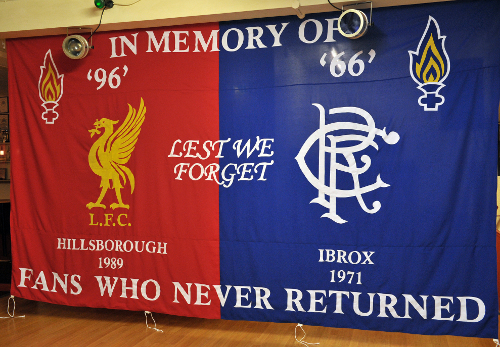
Sundays Old Firm Game coincides with the 40th Anniversary of the Ibrox Disaster when 66 Rangers Fans lost the life's after watching the team they loved.
May They all Rest in Peace
Stairway 13
Stairway 13, long before there was Heysel or Hilllsborough, with their grim television pictures, incongruous floral tributes and uncomprehending vales of tears, there was one Saturday evening in Glasgow on which a city***8217;s mothers and fathers, wives and girlfriends, nephews and nieces, and heaven only knows how many friends of a friend, clung on anxiously to the hope that their loved ones would eventually stagger through the door and confirm they had escaped the terrible devastation wrought by the Ibrox Disaster.
Most of the them did come home, whether three sheets in the wind or as fu***8217; as a whelk. Others such as Walter Smith, Alex Ferguson and Andy Roxburgh clambered around the mangle of bodies and stricken souls, emergency workers and Old Firm volunteers on Stairway 13, and thanked their lucky stars in one breath, prior to collecting their thoughts in the next. But, for 66 other families, there was the spectre of a long night***8217;s journey into day and the awful realisation that the catastrophe which engulfed Ibrox at the end of the New Year match on January 2, 1971, had snatched their sons and - in Margaret Ferguson***8217;s case - daughter away forever.
Even now, almost 30 years later, the sepia-tinged pictures from the newsreels speak of mystification and bewilderment, accompanied by a sense of futile anger at the casual fashion in which so many lives were sacrificed. But, beyond that, there is also a numbing tristesse amongst those three-score-plus families, reflecting their feeling that hackneyed phrases in the mould of "time is a healer" and "they***8217;re in a better place now" are cute platitudes for those fortunate enough never to have had to identify relatives with their faces black and the life squeezed out of them.
Talk to men such as Sandy Jardine or John Greig and you will not hear any easy sentiments, but rather the hushing of voices and stilling of laughter, followed by their own, particular, memories of a calamity which, all too fleetingly, tore through Glasgow***8217;s intransigent sectarian curtain and saw Orangemen shed tears in the company of priests throughout the west of Scotland, yonder into Edinburgh and across the Kingdom to the little Fife village of Markinch, where Peter Easton, Richard Morrison, David Patton, Mason Phillips and Bryan Todd, five schoolboys who lived within a few hundred yards of each other, perished together on the same ill-fated stairway, which had witnessed earlier tragedies in 1961, and near-disasters in 1967 and 1969.
Sitting in his office at the refurbished Ibrox nowadays, Jardine cuts a blithe and dapper figure, his youthful countenance belying the fact that he will turn 52 this Hogmanay, a mere two days before Rangers unveil a bronze statue in tribute to the fans who died and in remembrance of the hundreds of others in the 80,000 crowd who suffered serious injuries and/or emotional scars which no amount of modern counselling will erase.
"In these days, this was probably the biggest fixture of the season, given that the Old Firm only met twice a year, but it was dreadfully ironic that what had been a fairly good-natured occasion, with neither trouble on the terraces or on the pitch, should develop into a waking nightmare for so many people," says Jardine. "Everyone knows the circumstances whereby Jimmy Johnstone sent Celtic in front with a minute to go, the ball got centred, we equalised at once, [through Colin Stein] and the referee blew full-time immediately. So you had Rangers supporters, who thought: ***8216;Oh, that***8217;s the game over", when Jimmy scored, turning to go down the big staircase, then turning back when they heard the huge roar, and that coincided with a massive number of spectators making their way towards the exit and the subway. Then, suddenly, somebody fell, and the whole ghastly business began.
"The thing is, I was on the groundstaff, I had actually swept these stairways, and they were huge, really solid objects, so I could never understand how they could get mangled so badly by any number of human beings. But they were. Just think of it: the pressure of all those bodies cascading over one another, and the panic which must have spread...ach, there are no words in the English language to describe adequately what happened over those next few minutes.
"But you have to realise that we, as players, were completely unaware anything was wrong at that stage. We were in our dressing-room, fairly happy to have managed a draw, sharing a few jokes together before getting into the bath. Well, I was one of the last guys to climb out, but as I re-emerged the order came that there had been an accident and we had to leave the room as quickly as possible. It could have been a fire alert or anything, but while we started putting our clothes on as fast as we could, the authorities started to bring some of the dead bodies into the place, and we all turned grey at the sight of them.
"Yet even then, we had no real idea of the extent of the fatalities. As I drove back to my home in the east end of Edinburgh, I heard there were two dead, then the figures mounted up. It was 12, then 22, then 30, then 44 - I don***8217;t know why, but that number sticks in my mind - and finally, it climbed to 66 as the news filtered out to all the parents and kith and kin of the folk who had attended the match and had gone to pubs or picture houses afterwards. I***8217;ve spoken to hundreds of supporters since then, and they***8217;ve told me how vast crowds assembled at all of the drop-off points for the buses to find out whether their loved ones were okay. The phone lines were jammed, Glasgow was in turmoil, and the hospitals were all packed to overflowing. Anxiety, terror, pain, sadness, horror...a blanket of all these emotions covered our whole country that night."
Amidst this maelstrom, Willie Waddell, the 50-year-old Rangers manager, somehow brought a semblance of sanity to the madhouse, he and his Celtic counterpart Jock Stein emphasising constantly the desperate need for entrenched communities to pull together and for religious tribalism to be discarded. Sadly, but perhaps inevitably, considering the basic illogicality of the extremists on either side, the "healing" process proved little more than a nine-day wonder.
But in the longer-term, Waddell, who died in 1992, was determined such scenes should never be repeated at Ibrox. "It***8217;s strange what comes into your mind, but when I first went to the top of the steps and looked down on the pile of bodies, my initial thought was of Belsen, because the corpses were entangled as they had been in the pictures which came out of the concentration camps," said Waddell. "But, my God, it was hellish, there were bodies in the dressing rooms, in the gymnasium, and even in the laundry room. My own training staff and the Celtic training staff were working at the job of resuscitation, and we were all trying everything possible to bring breath back to those crushed limbs.
"Honestly, I will never forget the sight of Bob Rooney, the Celtic psyhiotherapist, with tears in his eyes giving the kiss of life to innumerable victims. He never stopped, nor did the Rangers doctors, nor the nurses and ambulancemen who flocked to join them, and we will never know how many lives were saved in there during that frenzy of activity."
Nearby, the Southern General Hospital was under siege, their switchboard of only 35 lines - and one police short-wave radio - incessantly jammed by a crescendo of panic calls from every corner of the city. But by midnight, a worse task was unfolding for the likes of Jardine and Greig. The funerals. The search for answers. And the quest towards apportioning responsibility which, despite lengthy inquiries, found little beyond the same tinder-box of ingredients which would bring death and destruction to the realms of Heysel, Bradford and Hillsborough as much as 18 years later.
"Willie was a tremendous influence on us, and when he instructed the players to report into Ibrox on Monday morning we accepted that we had to shoulder the burden and carry the load for those who had lost their lives," says Jardine. "As he mentioned, players come and go, new faces are introduced and old heroes waved goodbye, but the supporters have a lifelong commitment to their club.
"So we went to the funerals and paid our respects, but as you might imagine, it was a terrible experience, especially in cases such as those young lads from Markinch. What could you say? What consolation could you offer? In the normal routine, when you go to a funeral of somebody who has reached a ripe old age, the occasion can be treated as a celebration of that person***8217;s life, but with these kids there is always the sense of unfulfilled potential, of existence snuffed away, and that is irreplaceable.
"I can***8217;t remember now exactly how many funerals Greigy and I went to, but every single one left an indelible impression on both of us and, almost 30 years on, I still find myself wondering what it must be like to be in the shoes of the families. That***8217;s why we are holding this memorial on January 2 - yes, ordinary Rangers fans can come along and pay their respects - but this is for the families. If nothing else, the new Ibrox, where safety is the paramount priority, stands as their monument, and we have already contacted 64 of the 66 families involved in this tragedy. Believe me, we genuinely want to handle this properly, with due dignity and decorum."
Jardine***8217;s words, and the quiver on his lips, demonstrate the fashion in which recollections of 1971 can induce sorrow in the most hardened character. Greig, for instance, as coruscating and rumbustious a customer as ever wore the captain***8217;s armband at Rangers, might shuffle uneasily under the newspapers***8217; gaze in his role as head of public relations at Ibrox, but there is nothing stiff or stilted when the Disaster is discussed.
"It will never leave me. Never a day goes by that it doesn***8217;t pass through my mind. Indeed, I still receive letters from guys who have never been back at the stadium since that very day, and I can***8217;t blame them," says Greig. "But while it is in my power, I will offer to take them around the new stadium to enable them to see what it looks like now. Because, in the trophy room, there is a beautiful picture of the old stadium up on the wall. And for me, it is one of the most important things in the room, and I make a point of showing it to the people who go there. It***8217;s important, especially for the younger fans who have only witnessed the new Ibrox, that they know the history of the club, where we came from, and why we advanced from that point.
" No amount of mourning will yield solace to the step-sister of Margaret Ferguson, or dispel thoughts of what might have been amongst the minions of Markinch. But if next month***8217;s ceremony brings re-union between those factions who combined for the common good in 1971, it surely won***8217;t be a vain gesture.
The teams on that tragic day, January 2, 1971
RANGERS 1 (Stein, 90)
Neef Jardine Mathieson Greig McKinnon Jackson Henderson Conn Johnstone Smith Stein
CELTIC 1 (Johnstone, 89)
Williams Craig Gemmell Brogan Connolly Hay Johnstone Hood Wallace Callaghan Lennox
The list of those who lost their lives on that day:
GLASGOW
DAVID ANDERSON [45], JOHN BUCHANAN [32], RICHARD BARKE [15], DAVID DUFF [23), PETER FARRIES [26], JOHN GARDINER [32], THOMAS GRANT [16], CHARLES LIVINGSTON [30], BRIAN HUTCHINSON [16], JOHN JEFFREY [16], ANDREW LINDSAY [18], THOMAS MELVILLE [17], FRANCIS DOVER [16], ROBERT MULHOLLAND [16], DUNCAN McBREARTY [17], DONALD McPHERSON [30], THOMAS McROBBIE [17], ROBERT RAE [25], WILLIAM SHAW [30], WALTER SHIELDS, GEORGE SMITH [40], WILLIAM SOMERHILL [17], JAMES TRAINER [20]
JOHN CRAWFORD [23], GEORGE FINDLAY [21], JOHN NEIL.
LIVERPOOL
NIGEL PICKUP [9]
EDINBURGH
WALTER RAEBURN [36], JAMES SIBBALD [28], ROBERT C CAIRNS [17].
LANARKSHIRE
THOMAS DICKSON [32], IAN FREW [21], JAMES GREY [37], IAN HUNTER [14], JAMES MAIR [19], ROBERT MAXWELL [15], ALEXANDER ORR [16], MATTHEW RIED [49], CHARLES STIRLING [20], PETER WRIGHT [31]
ARGYLL
GEORGE IRWIN [22]
FIFE
PETER EASTON [13], MARTIN PATON [14], MASON PHILLIPS [14], BRIAN TODD [14], DOUGLAS MORRISON [15]
RENFREWSHIRE
HUGH ADDIE [33], ROBERT GRANT [21], ALEX McINTYRE [29], GEORGE WILSON [15]
STIRLINGSHIRE
MARGARET FERGUSON [18], ROBERT McADAM [36], RICHARD McLEAY [28], JOHN McLEAY [23]
WEST LOTHIAN
RUSSEL MALCOLM [16]
DUMBARTONSHIRE
GEORGE ADAMS [43], ROBERT CARRIGAN [13], CHARLES DOUGAN [31], ADAM HENDERSON, DAVID McGHEE [14], THOMAS MORGAN [14], JAMES RAE [19], JOHN SEMPLE [18], THOMAS STIRLING [16], DONALD SUTHERLAND [14].
EAST LOTHIAN
JAMES McGOVERN [24]
May They all Rest in Peace

Stairway 13
Stairway 13, long before there was Heysel or Hilllsborough, with their grim television pictures, incongruous floral tributes and uncomprehending vales of tears, there was one Saturday evening in Glasgow on which a city***8217;s mothers and fathers, wives and girlfriends, nephews and nieces, and heaven only knows how many friends of a friend, clung on anxiously to the hope that their loved ones would eventually stagger through the door and confirm they had escaped the terrible devastation wrought by the Ibrox Disaster.
Most of the them did come home, whether three sheets in the wind or as fu***8217; as a whelk. Others such as Walter Smith, Alex Ferguson and Andy Roxburgh clambered around the mangle of bodies and stricken souls, emergency workers and Old Firm volunteers on Stairway 13, and thanked their lucky stars in one breath, prior to collecting their thoughts in the next. But, for 66 other families, there was the spectre of a long night***8217;s journey into day and the awful realisation that the catastrophe which engulfed Ibrox at the end of the New Year match on January 2, 1971, had snatched their sons and - in Margaret Ferguson***8217;s case - daughter away forever.
Even now, almost 30 years later, the sepia-tinged pictures from the newsreels speak of mystification and bewilderment, accompanied by a sense of futile anger at the casual fashion in which so many lives were sacrificed. But, beyond that, there is also a numbing tristesse amongst those three-score-plus families, reflecting their feeling that hackneyed phrases in the mould of "time is a healer" and "they***8217;re in a better place now" are cute platitudes for those fortunate enough never to have had to identify relatives with their faces black and the life squeezed out of them.
Talk to men such as Sandy Jardine or John Greig and you will not hear any easy sentiments, but rather the hushing of voices and stilling of laughter, followed by their own, particular, memories of a calamity which, all too fleetingly, tore through Glasgow***8217;s intransigent sectarian curtain and saw Orangemen shed tears in the company of priests throughout the west of Scotland, yonder into Edinburgh and across the Kingdom to the little Fife village of Markinch, where Peter Easton, Richard Morrison, David Patton, Mason Phillips and Bryan Todd, five schoolboys who lived within a few hundred yards of each other, perished together on the same ill-fated stairway, which had witnessed earlier tragedies in 1961, and near-disasters in 1967 and 1969.
Sitting in his office at the refurbished Ibrox nowadays, Jardine cuts a blithe and dapper figure, his youthful countenance belying the fact that he will turn 52 this Hogmanay, a mere two days before Rangers unveil a bronze statue in tribute to the fans who died and in remembrance of the hundreds of others in the 80,000 crowd who suffered serious injuries and/or emotional scars which no amount of modern counselling will erase.
"In these days, this was probably the biggest fixture of the season, given that the Old Firm only met twice a year, but it was dreadfully ironic that what had been a fairly good-natured occasion, with neither trouble on the terraces or on the pitch, should develop into a waking nightmare for so many people," says Jardine. "Everyone knows the circumstances whereby Jimmy Johnstone sent Celtic in front with a minute to go, the ball got centred, we equalised at once, [through Colin Stein] and the referee blew full-time immediately. So you had Rangers supporters, who thought: ***8216;Oh, that***8217;s the game over", when Jimmy scored, turning to go down the big staircase, then turning back when they heard the huge roar, and that coincided with a massive number of spectators making their way towards the exit and the subway. Then, suddenly, somebody fell, and the whole ghastly business began.
"The thing is, I was on the groundstaff, I had actually swept these stairways, and they were huge, really solid objects, so I could never understand how they could get mangled so badly by any number of human beings. But they were. Just think of it: the pressure of all those bodies cascading over one another, and the panic which must have spread...ach, there are no words in the English language to describe adequately what happened over those next few minutes.
"But you have to realise that we, as players, were completely unaware anything was wrong at that stage. We were in our dressing-room, fairly happy to have managed a draw, sharing a few jokes together before getting into the bath. Well, I was one of the last guys to climb out, but as I re-emerged the order came that there had been an accident and we had to leave the room as quickly as possible. It could have been a fire alert or anything, but while we started putting our clothes on as fast as we could, the authorities started to bring some of the dead bodies into the place, and we all turned grey at the sight of them.
"Yet even then, we had no real idea of the extent of the fatalities. As I drove back to my home in the east end of Edinburgh, I heard there were two dead, then the figures mounted up. It was 12, then 22, then 30, then 44 - I don***8217;t know why, but that number sticks in my mind - and finally, it climbed to 66 as the news filtered out to all the parents and kith and kin of the folk who had attended the match and had gone to pubs or picture houses afterwards. I***8217;ve spoken to hundreds of supporters since then, and they***8217;ve told me how vast crowds assembled at all of the drop-off points for the buses to find out whether their loved ones were okay. The phone lines were jammed, Glasgow was in turmoil, and the hospitals were all packed to overflowing. Anxiety, terror, pain, sadness, horror...a blanket of all these emotions covered our whole country that night."
Amidst this maelstrom, Willie Waddell, the 50-year-old Rangers manager, somehow brought a semblance of sanity to the madhouse, he and his Celtic counterpart Jock Stein emphasising constantly the desperate need for entrenched communities to pull together and for religious tribalism to be discarded. Sadly, but perhaps inevitably, considering the basic illogicality of the extremists on either side, the "healing" process proved little more than a nine-day wonder.
But in the longer-term, Waddell, who died in 1992, was determined such scenes should never be repeated at Ibrox. "It***8217;s strange what comes into your mind, but when I first went to the top of the steps and looked down on the pile of bodies, my initial thought was of Belsen, because the corpses were entangled as they had been in the pictures which came out of the concentration camps," said Waddell. "But, my God, it was hellish, there were bodies in the dressing rooms, in the gymnasium, and even in the laundry room. My own training staff and the Celtic training staff were working at the job of resuscitation, and we were all trying everything possible to bring breath back to those crushed limbs.
"Honestly, I will never forget the sight of Bob Rooney, the Celtic psyhiotherapist, with tears in his eyes giving the kiss of life to innumerable victims. He never stopped, nor did the Rangers doctors, nor the nurses and ambulancemen who flocked to join them, and we will never know how many lives were saved in there during that frenzy of activity."
Nearby, the Southern General Hospital was under siege, their switchboard of only 35 lines - and one police short-wave radio - incessantly jammed by a crescendo of panic calls from every corner of the city. But by midnight, a worse task was unfolding for the likes of Jardine and Greig. The funerals. The search for answers. And the quest towards apportioning responsibility which, despite lengthy inquiries, found little beyond the same tinder-box of ingredients which would bring death and destruction to the realms of Heysel, Bradford and Hillsborough as much as 18 years later.
"Willie was a tremendous influence on us, and when he instructed the players to report into Ibrox on Monday morning we accepted that we had to shoulder the burden and carry the load for those who had lost their lives," says Jardine. "As he mentioned, players come and go, new faces are introduced and old heroes waved goodbye, but the supporters have a lifelong commitment to their club.
"So we went to the funerals and paid our respects, but as you might imagine, it was a terrible experience, especially in cases such as those young lads from Markinch. What could you say? What consolation could you offer? In the normal routine, when you go to a funeral of somebody who has reached a ripe old age, the occasion can be treated as a celebration of that person***8217;s life, but with these kids there is always the sense of unfulfilled potential, of existence snuffed away, and that is irreplaceable.
"I can***8217;t remember now exactly how many funerals Greigy and I went to, but every single one left an indelible impression on both of us and, almost 30 years on, I still find myself wondering what it must be like to be in the shoes of the families. That***8217;s why we are holding this memorial on January 2 - yes, ordinary Rangers fans can come along and pay their respects - but this is for the families. If nothing else, the new Ibrox, where safety is the paramount priority, stands as their monument, and we have already contacted 64 of the 66 families involved in this tragedy. Believe me, we genuinely want to handle this properly, with due dignity and decorum."
Jardine***8217;s words, and the quiver on his lips, demonstrate the fashion in which recollections of 1971 can induce sorrow in the most hardened character. Greig, for instance, as coruscating and rumbustious a customer as ever wore the captain***8217;s armband at Rangers, might shuffle uneasily under the newspapers***8217; gaze in his role as head of public relations at Ibrox, but there is nothing stiff or stilted when the Disaster is discussed.
"It will never leave me. Never a day goes by that it doesn***8217;t pass through my mind. Indeed, I still receive letters from guys who have never been back at the stadium since that very day, and I can***8217;t blame them," says Greig. "But while it is in my power, I will offer to take them around the new stadium to enable them to see what it looks like now. Because, in the trophy room, there is a beautiful picture of the old stadium up on the wall. And for me, it is one of the most important things in the room, and I make a point of showing it to the people who go there. It***8217;s important, especially for the younger fans who have only witnessed the new Ibrox, that they know the history of the club, where we came from, and why we advanced from that point.
" No amount of mourning will yield solace to the step-sister of Margaret Ferguson, or dispel thoughts of what might have been amongst the minions of Markinch. But if next month***8217;s ceremony brings re-union between those factions who combined for the common good in 1971, it surely won***8217;t be a vain gesture.
The teams on that tragic day, January 2, 1971
RANGERS 1 (Stein, 90)
Neef Jardine Mathieson Greig McKinnon Jackson Henderson Conn Johnstone Smith Stein
CELTIC 1 (Johnstone, 89)
Williams Craig Gemmell Brogan Connolly Hay Johnstone Hood Wallace Callaghan Lennox
The list of those who lost their lives on that day:
GLASGOW
DAVID ANDERSON [45], JOHN BUCHANAN [32], RICHARD BARKE [15], DAVID DUFF [23), PETER FARRIES [26], JOHN GARDINER [32], THOMAS GRANT [16], CHARLES LIVINGSTON [30], BRIAN HUTCHINSON [16], JOHN JEFFREY [16], ANDREW LINDSAY [18], THOMAS MELVILLE [17], FRANCIS DOVER [16], ROBERT MULHOLLAND [16], DUNCAN McBREARTY [17], DONALD McPHERSON [30], THOMAS McROBBIE [17], ROBERT RAE [25], WILLIAM SHAW [30], WALTER SHIELDS, GEORGE SMITH [40], WILLIAM SOMERHILL [17], JAMES TRAINER [20]
JOHN CRAWFORD [23], GEORGE FINDLAY [21], JOHN NEIL.
LIVERPOOL
NIGEL PICKUP [9]
EDINBURGH
WALTER RAEBURN [36], JAMES SIBBALD [28], ROBERT C CAIRNS [17].
LANARKSHIRE
THOMAS DICKSON [32], IAN FREW [21], JAMES GREY [37], IAN HUNTER [14], JAMES MAIR [19], ROBERT MAXWELL [15], ALEXANDER ORR [16], MATTHEW RIED [49], CHARLES STIRLING [20], PETER WRIGHT [31]
ARGYLL
GEORGE IRWIN [22]
FIFE
PETER EASTON [13], MARTIN PATON [14], MASON PHILLIPS [14], BRIAN TODD [14], DOUGLAS MORRISON [15]
RENFREWSHIRE
HUGH ADDIE [33], ROBERT GRANT [21], ALEX McINTYRE [29], GEORGE WILSON [15]
STIRLINGSHIRE
MARGARET FERGUSON [18], ROBERT McADAM [36], RICHARD McLEAY [28], JOHN McLEAY [23]
WEST LOTHIAN
RUSSEL MALCOLM [16]
DUMBARTONSHIRE
GEORGE ADAMS [43], ROBERT CARRIGAN [13], CHARLES DOUGAN [31], ADAM HENDERSON, DAVID McGHEE [14], THOMAS MORGAN [14], JAMES RAE [19], JOHN SEMPLE [18], THOMAS STIRLING [16], DONALD SUTHERLAND [14].
EAST LOTHIAN
JAMES McGOVERN [24]




 It only would have taken one idiot today to spoil it and I'm so glad the up most respect was paid. I hope it's been quiet in Glasgow in terms of trouble tonight.


Comment